As of today, the story is posted through chapter 41 (of 55)! But it’s all there, so you can go back and read to catch up if you’re just starting on it now. The final chapters will be posted on Oct. 30, the day before Halloween.

As of today, the story is posted through chapter 41 (of 55)! But it’s all there, so you can go back and read to catch up if you’re just starting on it now. The final chapters will be posted on Oct. 30, the day before Halloween.
I just posted chapters 4 and 5 of Black Diamond. You can read them here. And the older chapters will remain posted so you can catch up at any time! https://mcculloughblackdiamond.substack.com/p/black-diamond-chapters-4-5
My experiment in giving away a novel on Substack begins today. Here’s the first promo graphic I’ve done:
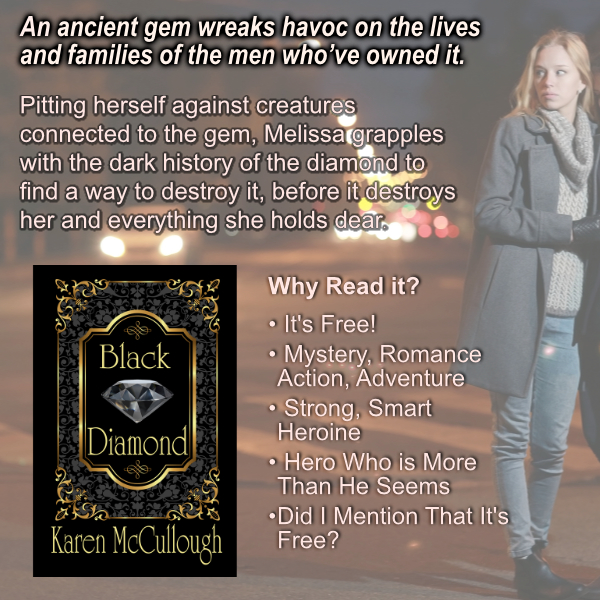
This is an experiment! I’m giving away one of my never-before-published books – totally free! You just have to sign up for the Substack list here , and the chapters will be delivered to you every couple of days. (And by the way, I will never sell or otherwise distribute your information. You can read my privacy policy here and Substack’s is here.)
Sometime before the final chapters are posted (and just so you know, there are around 50 of them), I will make the book available in ebook and paperback at most major retailers, but I promise you that I will also post the complete thing here over the next couple of months.
What is Black Diamond?
The novel defies easy genre categorization. It is part romance, part mystery, part paranormal thriller, part adventure, part family drama. I hope it is entirely entertaining. The story is set in contemporary times, in the town of Montclair, N.J., with flashback chapters to older times. A resourceful and intelligent female protagonist is matched with a male love interest who is much more than he seems and pitted against an ancient evil that threatens to destroy everyone she cares for. I should make clear that I wrote this novel entirely myself. No AI was ever used in its creation.
An ancient gem wreaks havoc on the lives and families of the men who’ve owned it.
Melissa Kinelly’s normal life shatters when her brother comes home with a diamond ear stud that transforms him from normal college student to a raging human volcano always on the verge of a violent eruption. After the private investigator she hires to research the diamond’s history is murdered, she takes on the investigation herself, with the reluctant help of the manager of the pawn shop where her brother bought the diamond. Pitting herself against a group of monstrous creatures connected to the gem, she grapples with the dark history of the diamond to find a way to destroy it before it destroys her and everything she holds dear.
When Does it Start?
I’ll post the first three chapters on Tuesday, Sept 8, 2026. After that, I’ll post a chapter or two, depending on length, every few days until it is complete. My hope is to finish posting around the end of October.
Can I Read All of It Even if I Come in Late?
Yes, for sure. You can come back to the Substack site to read chapters you might have missed. The entire story will remain posted on Substack, at least until the end of the year. Beyond that, I haven’t decided. But it will also be posted for sale at all major book retailers.
Is This Story in the Public Domain?
NO! Black Diamond is copyrighted by me, so I ask that you if you want to share the story, please do so by forwarding the Substack email or direct link. It’s hard enough to be an author these days. Please don’t make my life even harder by copying the text in any way, shape, or form.
Sign up to receive Black Diamond:
 My three children are widely scattered, one in Beaufort, NC, one in South Bend, Indiana, and one in Kent, England. All three have children of their own, so I am grandmother to eight. They’ve remained friends over the years, but distance means they can’t all get together very often.
With my son in England, we’ve generally alternated years for traveling to visit during the summer. Last year, my son suggested that for his family’s turn to come over here, we do something that would allow his children to meet and get to know their cousins, who they’d last seen almost four years ago.
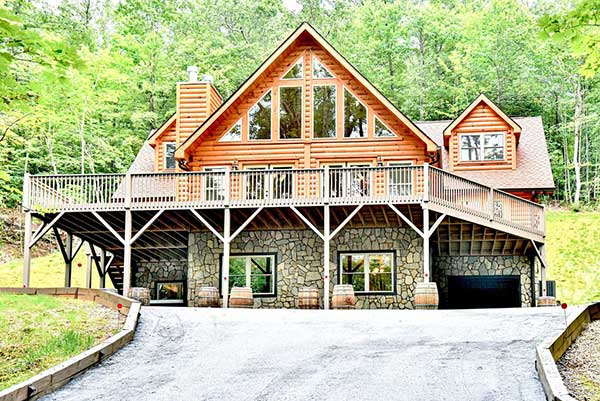
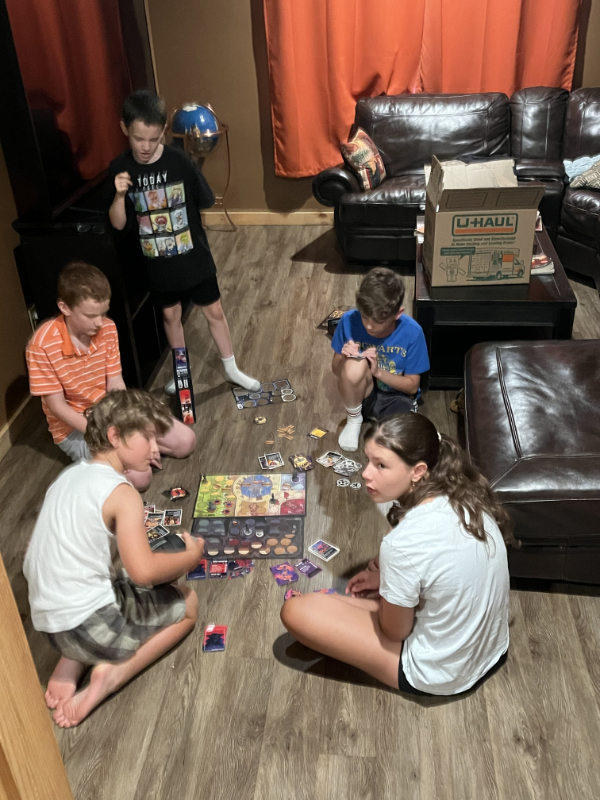
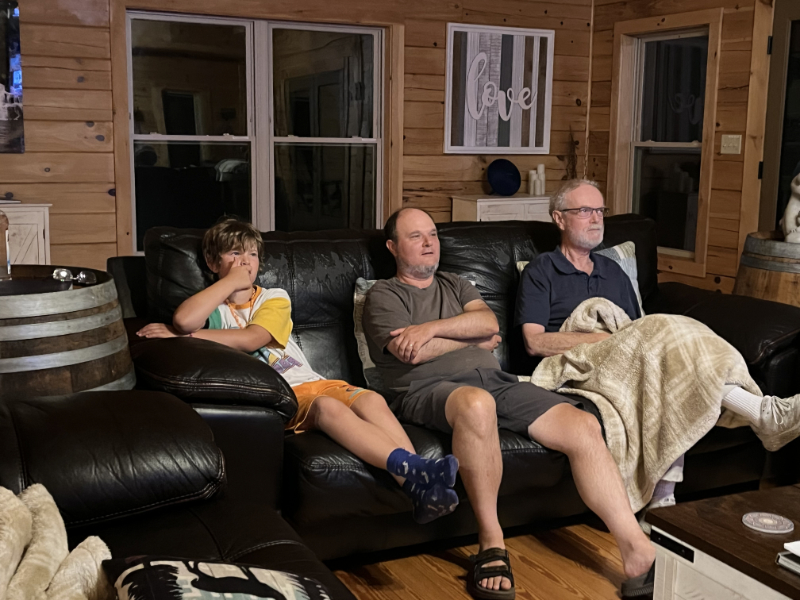
I rented a large cabin (not as rustic as that sounds) in Black Mountain for the first week in August. Joe and Steph with Freya and James flew over from England, Liz joined us from Beaufort, and Sarah, her husband, and her four boys drove down from Indiana to meet us there.
 We had a fabulous week. Despite the threat of rain, it held off enough most days that we were able to get in the activities we wanted to do. The same for the sickness that threatened. Even the flat tire on the rental car (yes, again!) failed to slow us down much. (And I will definitely be renewing that Triple-A membership!)
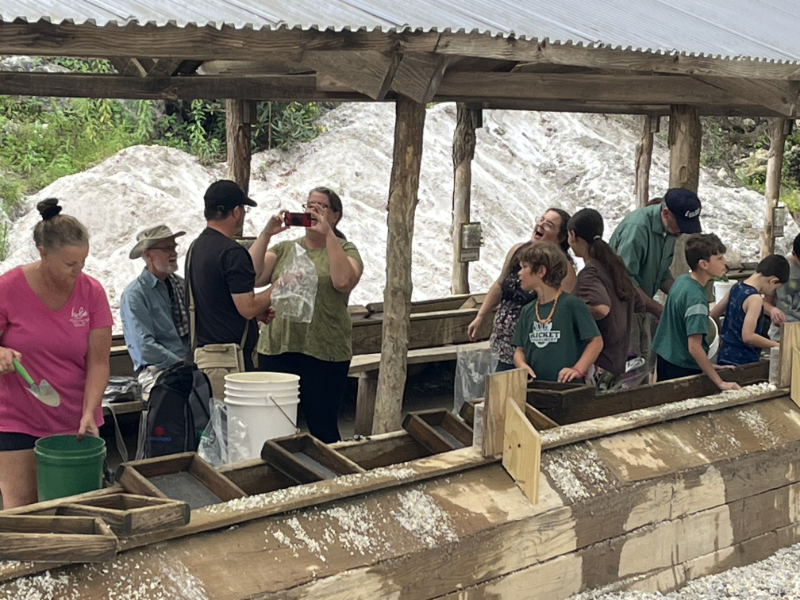
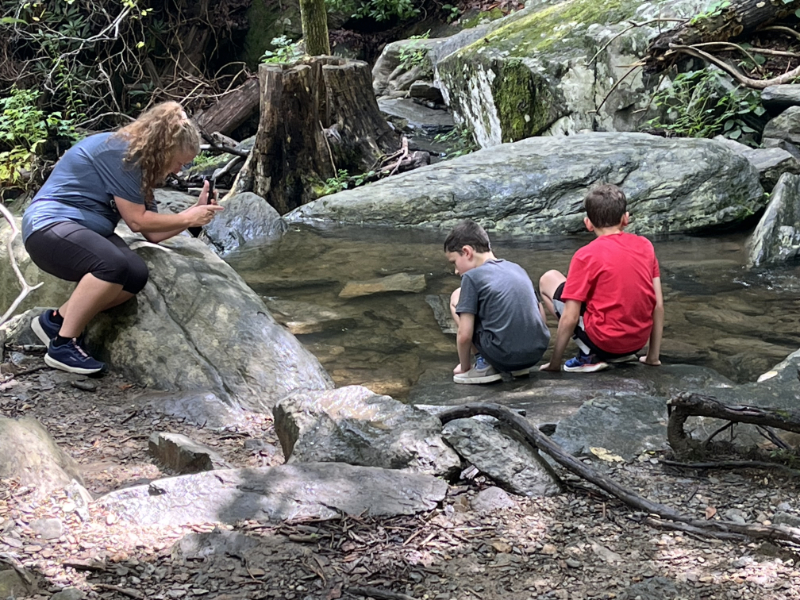
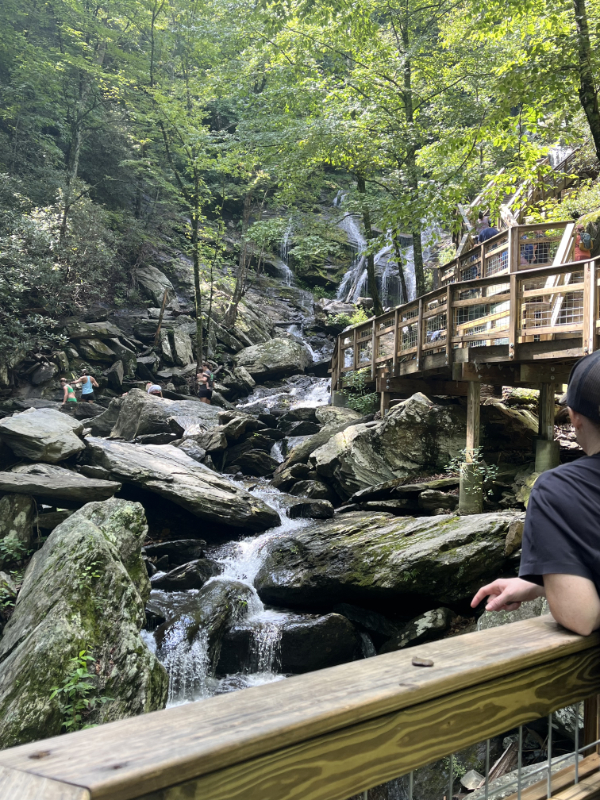
We took the children gem mining at Emerald Village and they had a blast. We visited the 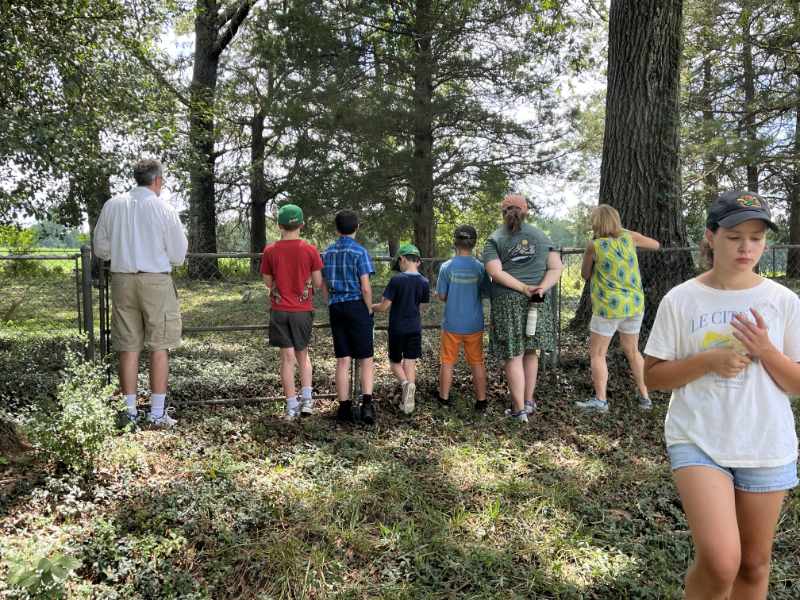 farm where my husband grew up for a day. When they heard we were coming, many of the extended McCullough family made the effort to join us there (and brought tons of food!) We had a few other assorted side trips that various people took to Asheville, the town of Black Mountain, some local hiking trails, and we finished it off with a trip to Catawba Falls. The Falls are divided into lower and upper falls. Reaching the upper falls meant climbing around 500 steps, so some of us were content with viewing the falls from the bottom.
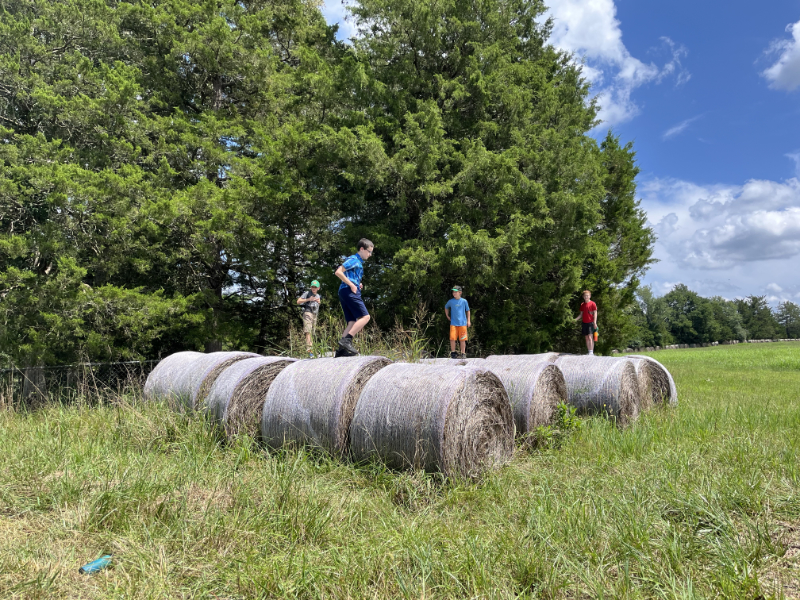 The week went way too fast. I felt like I barely had any time at all with some of the family. Due to the imminent start of school the following week, Sarah and her family had to head back to South Bend and Liz needed to get back to work.
We still had some time with Joe and his family before they returned to England, but we’d already made some wonderful memories with the whole family.
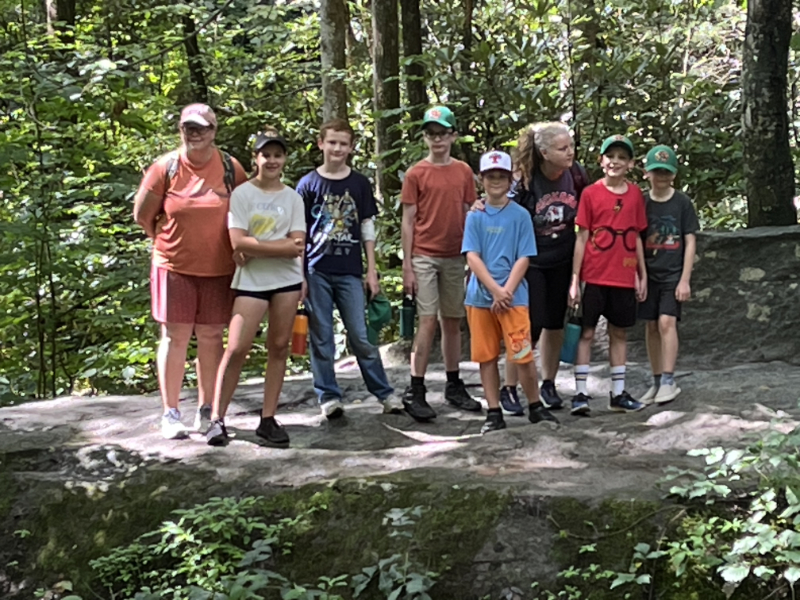 My one regret is I never got a group picture of all of us, though I did get one (at a distance) of all of the children.
But when we got home we did a few more side trips with Joe and his family, visiting the Greensboro Batting Center so everyone could try out the batting cages, Common Grounds — the local coffee shop, and Urban Air, an extensive indoor play spot. More on that later.
It was tough saying goodbye to everyone, but great memories remain.
I’m trying to give some love to an older book that I re-released several years ago and have pretty much neglected since . But I still think The Wizard’s Shield is a rollicking good story! To encourage people to try it, I’ve lowered the price to just $.99 for the rest of the month of July. Particularly for fans of Ilona Andrews, Jim Butcher, and Patricia Briggs – Why not try this contemporary, paranormal, romantic suspense novel?
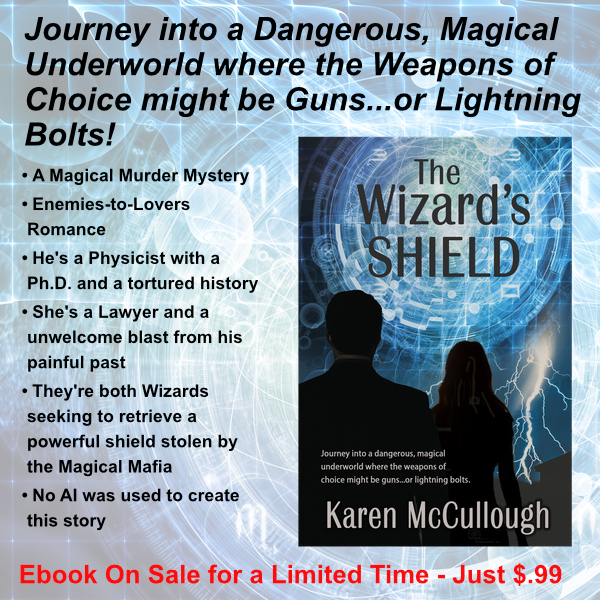 Kindle: https://www.amazon.com/dp/B0060Y5IQ6
Nook: https://www.barnesandnoble.com/w/the-wizards-shield-karen-mccullough/1114296122
Other ebook formats: https://books2read.com/u/4E1Bag
 It’s July in North Carolina and that means heat. Serious heat. Blast furnace levels of heat. And for the next few days we’re expecting some of the highest temperatures we’ve seen in several years, with highs around 98 today and in the 100s tomorrow, going back down to 99 for the 4th of July holiday.
We usually go to a baseball game on the 4th if our local team is in town, to enjoy All-American hot dogs, ice cream, and fireworks. The team is playing here, and the show will go forward, but without us this year. We’re just too old to sit for hours in 95+degree heat, even in shade and with plenty of cold beer and water available.
Instead, we’ll cook our own food at home, scoop our own ice cream, and watch a baseball game on television in the comfort of our air-conditioned living room.
On the Garden front, I try to get out most mornings to do some maintenance work while it’s still—relatively—cool. But when the day starts out at 81, I give myself a break and pass on the weeding and mulching.
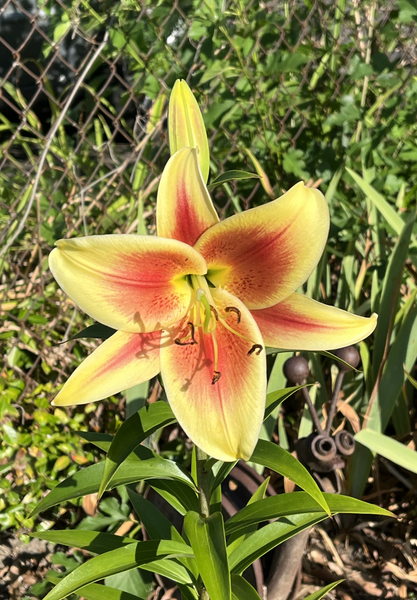
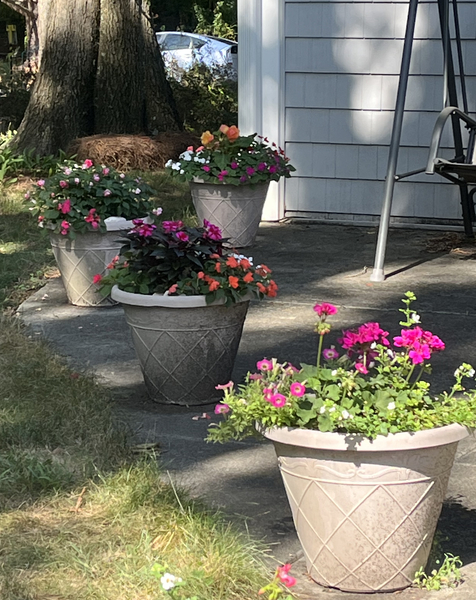
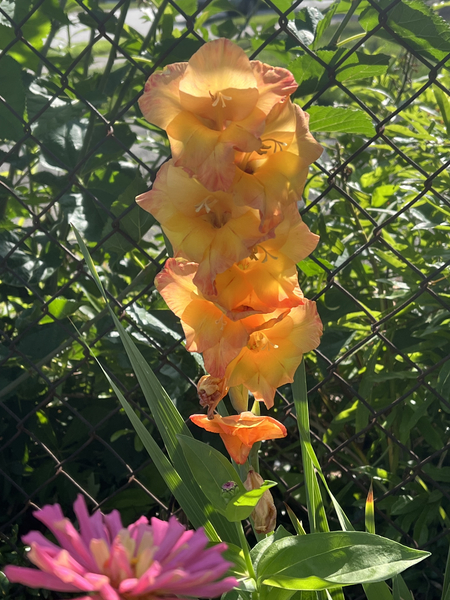
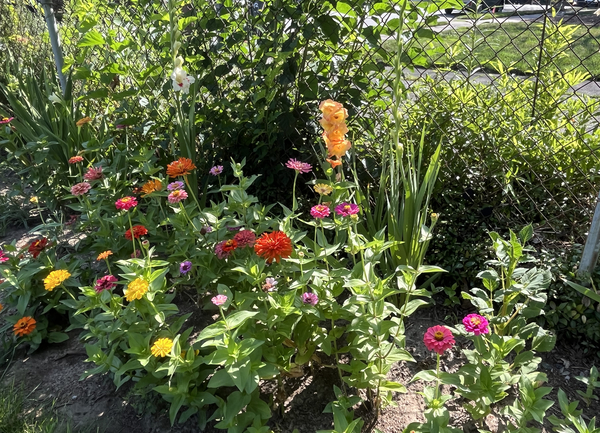
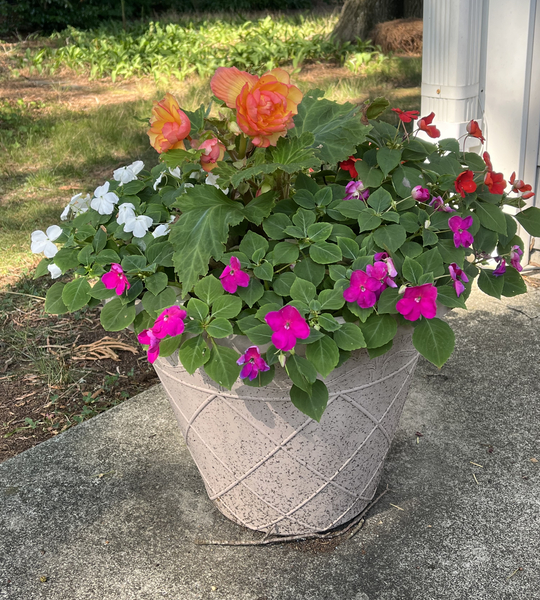 I do water the plants regularly when temperatures stay high and rain stays away, which is currently the case. And the garden is repaying me efforts with some pretty spectacular blooms. The pots on the patio are looking especially good this year, I think, but it will take daily watering to keep them happy when the daytime highs go above 90. It’s worth it to me when I get to sit on the porch swing in the shade and listen to the birds sing and admire the flowers surrounding me.
 My quickie 500-word romance flash story “Hold the Elevator” is the featured story in Micromance Magazine online this morning. Pop on over for a quick treat. You can read it for free here: https://micromancemagazine.substack.com/p/hold-the-elevator
Cut to the chase: I loved it. I liked the book a lot when I read it a couple of years ago, after a recommendation from my sister. Initially, I was taken aback to discover the book featured an octopus as a main character, but I trust Barbara’s judgement, so I got a copy and dove in.
The book has both heart and brains, although it might rely too heavily on a long-shot coincidence for its resolution. Still, I admit it was emotionally satisfying. The story does a great job of exploring the emptiness created by loss of loved ones and the ways people try (or don’t) to fill up that void.
The movie also leaned into that theme of loss versus connection in a way that felt natural and realistic. In exploring the secondary theme of the meaning of “home,” I felt the movie actually did a slightly better job than the book. (However, I read the book at least two years ago and I’m not a person who remembers every detail of a story.)
A lot of the movie’s resonance is due to the strong performances by all of the cast. Sally Field reminds us why she has won all those acting awards, including a couple of Oscars. She sinks into the role of Tova, the “cleaning lady” at the aquarium where Marcellus, the octopus, unhappily resides. She does the job as a way to cope with the loss of both her husband and her only son. Field is great at good-hearted grumpy. Her connection with Marcellus is both convincing and heart-breaking. For a scene near the end where Tova makes a shattering connection, the camera focuses tightly on her face and she lets the viewer read every single moment of the emotions it brings. It’s a tour-de-force performance.
Lewis Pullman is almost equally effective as a young man with a good heart but a soul lost in the cosmos due to the psychic wounds of his father’s desertion and his mother’s tragic life and death. His search for his missing father brings him to Tova’s home town. A job at the aquarium pushes them into conflict.
With all this, I think Albert Molina’s work as the voice of Marcellus is underrated. His voicing gives the octopus a real and fascinating point of view along with emotional depth.
The direction and editing kept the story moving along at a snappy pace that still allowed time for secondary characters to provide interesting depth.
Visually, the film pays a lot of attention to the environmental details and surface textures – water tracks left by Marcellus, the wood paneling in Tova’s house, uneven planks on the dock, and the view across the water. It adds immediacy to the feeling of being in the story.
The nearly two-hour running time passed quickly with almost no “boring sections.” I was hooked from the very start and couldn’t look away until the end!
 My previous post considered the role of ideas in writing, especially fiction. The bottom line: ideas are important but not the most important factor in creating a story. Ideas are a starting point, but the real work is turning them into a plot and actually sitting down at the keyboard to pound it out.
Even before that, though, comes the work of considering all the ideas and figuring out which ones have the legs to carry a story. I have lots of ideas. They’re everywhere. Usually the starting point is something that happened, and I start thinking about the whys and hows, twisting the possibilities to find interesting possibilities.
For instance, there was a story a few days ago in the NY Times about the 1990s art theft at the Isabella Stewart Gardner museum, a crime still unsolved. Anything that’s still a mystery has lots of possibilities. Inside job? How was someone convinced to do this? What happened to the art, which has never been located? How does it affect some collector who can never show off his prizes? Can you imagine being an heir finding some of these paintings in your late uncle’s secret vault? What do you do?
Or consider a more average story about a murder-suicide. Happens a lot, unfortunately. But what if it was actually a double murder made to look like a murder-suicide? What happens if the victims turn out to have no obvious connection to each other?
Even an ordinary traffic accident might be something more sinister.
So, there you have a few ideas, but none of them are stories yet. The one about the heir finding stolen art work is close since it has an inherent conflict established, but it needs more development to become a story.
I hope this makes the point that it takes more than an idea. You have to take that idea and rub it up against something else to create a story. Another idea. A problem or a challenge. Put a character into the idea in a way that will make him or her uncomfortable—or worse. Then you watch what happens and how the character tries to resolve his problem.
Not all ideas work out. I’ve come up with some great situations but can’t find the right character or characters to make it into a story. Sometimes ideas I think are going to work just kind of fizzle out or don’t go anywhere. The main conflict isn’t clicking or the resolution is too obvious. Too often, I can’t take what sounded like a great idea and make it into something that’s actually interesting. Occasionally I get a great story but can’t come up with a satisfying resolution.
I know I’m not the only author who has a folder full of half-written stories sitting on their hard drive. Every now and again I go back through them, and occasionally I even have a breakthrough and realize where I was trying to go with one of them. It’s particularly satisfying when that happens.